
Our Advice on Underfloor Heating and Screed
At Screed It, we understand the need to keep any work scheduled for a project as quick, efficient, and cost-effective as possible. That is why we’ve provided some professional advice on underfloor heating and screed, how the two should be installed together (including minimum and maximum levels of screed thickness), and what you can do to ensure best practice when carrying out the work.
What is Underfloor Heating?
Underfloor heating (UFH) is a method of heating any interior space by generating heat underneath the floors of the property. It can be used simply to warm up the floor or it may even replace radiator systems entirely and become the primary source of heat indoors.
When you install underfloor heating, you will normally have the option of two system types. These are electrical systems and water systems. An electrical underfloor heating system will use cables to generate heat, while water-based underfloor heating systems will pump heated water through a series of pipes underneath your top floor layer.
Installing UFH Systems Underneath Screed
Starting from the bottom, a subfloor will consist of either a concrete slab or a beam and block which is then insulated by a waterproof membrane. This membrane should then be covered with a layer of thermal insulation. In most cases, this will either be polystyrene or mineral wool. There may also be occasions where it will be necessary to fit vapour insulation over the original thermal insulation layer.
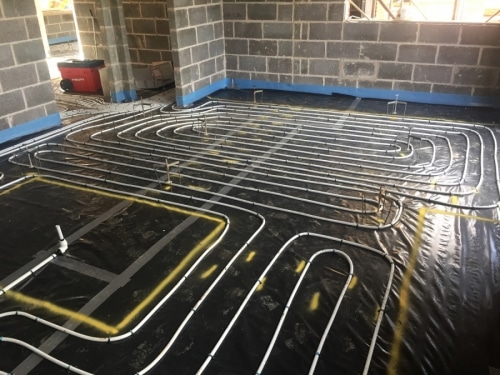
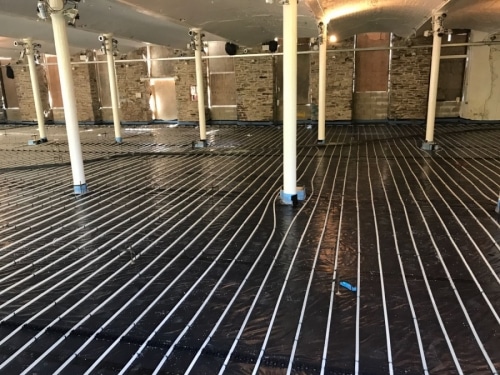
After this, the underfloor heating pipes can be fitted. These should be laid on the floor evenly, avoiding sharp bends if possible (as water-based pipes will need to maintain a free flow), and set out in a loop to ensure an even distribution of heat. The pipes should be fitted to the underlay with clips.
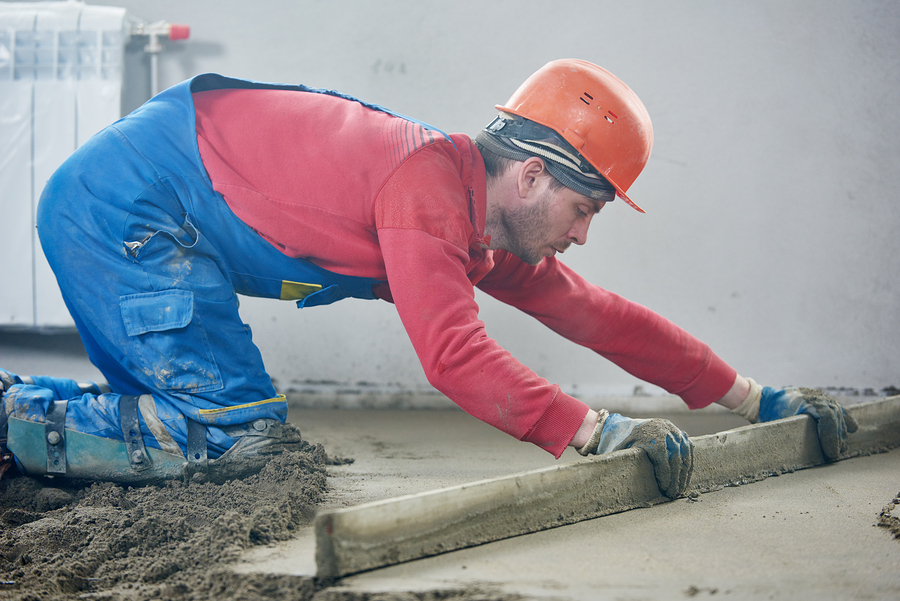
Once everything is in place and prepared, it will then be possible to install the screed mix that’s been chosen for the floor. This will then be left to dry, and a flooring of the homeowner or contractor’s choice can be laid to cover it over. Some may also choose to leave the screed exposed, as a stylish floor finish.
What is the Best Screed for Underfloor Heating?
There are two types of screed that can be installed around underfloor heating. Neither can be considered “best” for an underfloor heating installation, as they offer the same advantages when installed correctly. However, when considering an installation, you should always take into account the type of screed being used in order to allow room for thermal movement and expansion in the pipes.
We have provided some more information on the two types of floor screed mix below:
Traditional Floor Screed
Traditional sand and cement screeds, also called “dry screeds”, are a mix of coarse sand and cement. The ratio of sand to cement may vary depending on the contractor, but the average is normally noted as a 4:1 ratio mix. It also needs enough water to reach the required consistency without getting so wet that it will produce more than a few drops of moisture when squeezed.
Drying times for traditional types of screed will normally range between five and seven days.
A traditional floor screed will need a minimum of 28 days before the heating can be switched on, and the UFH system should be run at a low temperature at first to let the screed heat up. This assists in completing the cure before the heating is brought up to its full running temperature.
Liquid Screed
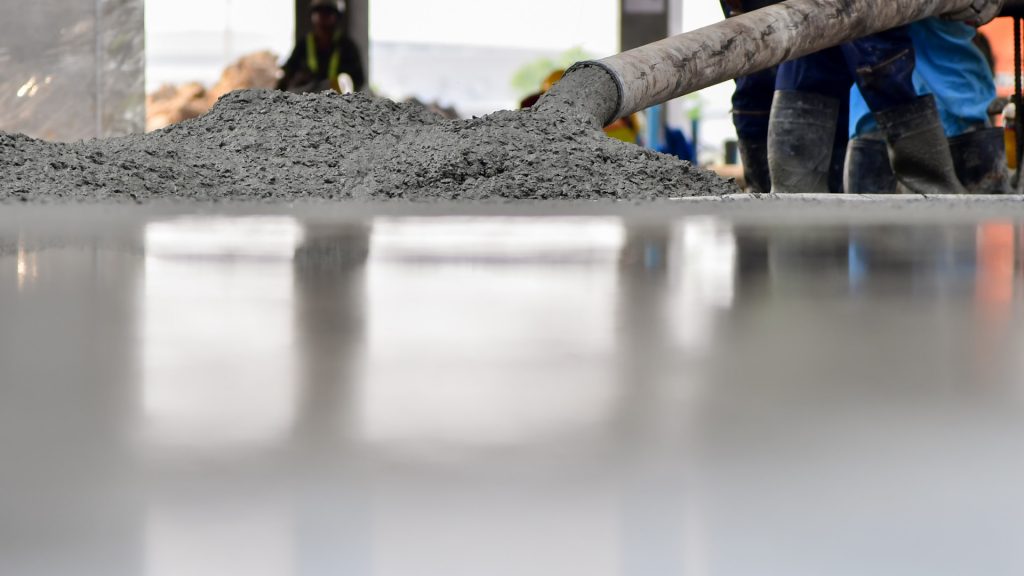
Also known as “flowing screeds”, liquid screeds are often considered a faster, more efficient alternative to traditional sand and cement screeds. This is because liquid screed can be supplied to a building project and simply poured into the space it needs to be installed. From there, the compound mix will harden by itself and form a smooth, flat surface. This is why they are often called self-levelling screeds as well.
If you are looking to finish a work project quickly, liquid screed is often the best choice. It can often be walked on within 24 to 48 hours of being installed, though it will take longer to cure than traditional screed.
Underfloor Heating and Screed Depth
It is especially important to keep to the recommended thickness of a screed layer, as the depth of the pipe determines how effectively the UFH system will distribute its heat. The thickness of the layer also varies, depending on whether you are using traditional sand and cement screed or liquid screed.
Ideally, a traditional sand and cement screed will have a minimum thickness of 65mm and a maximum thickness of 75mm. No matter the measurement chosen, this should be consistent throughout the work to keep the heat distribution the same.
As liquid floor screed can be installed in thinner layers than traditional screed, the minimum depth of the layer can be as little as 50mm or 55mm.
Preventing Issues with Underfloor Heating and Screed
When installing underfloor heating and covering it with a screed layer, there are a few other points to follow to ensure best practice:
- You should ensure that the process takes installations that penetrate floors into account
- You should always be aware of the maximum temperature of the floor surface, particularly if you are planning to install tiles above the screed
- Insulating the primary pipework and the manifold assemblies is highly recommended
- You should also be sure to locate the manifold assemblies so that they are easily accessed
- The correct labelling should be applied to all features in a UFH system, in order to keep inspections and maintenance efficient
- Joints between the manifold and pipework should be accommodated above the level of screed for easy maintenance
- Manifolds should be located at an appropriate height above the floor, securely fastened to the wall
- All external doors and windows should be installed before any UFH system, so that the property is watertight and the system is protected from frost
- The spacing and layout of the pipework should be even, but may be reduced around the external perimeter of rooms to compensate for additional heat loss that often occurs in these areas. Insulation will need to be installed from the floor to the edge of the walls
Underfloor heating pipes can be laid out in several patterns. The most appropriate layout for any particular system should be confirmed by the manufacturer.
If you don’t have the necessary experience to install underfloor heating with a screed layer to finish, we would strongly recommend calling a specialist service to undertake the work for you. This ensures that the work is handled correctly and will save you time and money that might otherwise be spent ripping up the screed floor and uninstalling the system if it goes wrong.
Contacting a Professional Screeding Service
If you are in need of fast and efficient screeding and underfloor heating services to complete your work project, contact Screed It today. We’ll do everything we can to provide you with the wet UFH system that keeps any property at its most comfortable temperature, and can ensure an installation is carried out exactly as you need. We will then finish the flooring with a layer of screed that suits the needs of your planned work.
We’ll be happy to carry out this work anywhere in the UK, and one of our members of staff will be ready and waiting to discuss everything you need as soon as you get in touch.
Купить диплом автомеханика. Хотите стать автомехаником, но не хотите проходить все тяжелые этапы обучения и получения диплома? Возможно, вы уже имеете опыт работы в этой сфере, но вам необходимо официальное подтверждение вашей квалификации? В таком случае, покупка диплома автомеханика может стать отличным решением для вас. Получение диплома автомеханика обычно требует не только времени, но и финансовых затрат. Не всегда есть возможность посещать учебные заведения или проходить курсы повышения квалификации. Однако, приобретение готового диплома купить аттестат за 9 класс может быть быстрым и удобным способом достичь поставленной цели. Когда вы покупаете диплом автомеханика, вы получаете официальный документ, подтверждающий вашу квалификацию. Это может быть полезно при трудоустройстве или при повышении ваших профессиональных навыков. Кроме того, наличие диплома перейти к статье может дать вам уверенность в себе и вашей способности выполнять задачи автомеханика. Приобретение диплома автомеханика может быть особенно полезным для тех, кто уже имеет опыт работы в этой сфере, но не имеет официального образования. Это позволит вам подтвердить свои знания и навыки перед работодателем и повысить свои шансы на успешное трудоустройство. Для того, чтобы купить диплом https://rd-diplomae.ru/tseny автомеханика, вам необходимо обратиться к специализированным компаниям или частным лицам, предлагающим такие услуги. Необходимо убедиться в надежности продавца и качестве предлагаемого документа. Важно также помнить, что покупка диплома должна быть осуществлена в соответствии с законодательством вашей страны. При выборе компании или лица, у которых вы планируете приобрести диплом автомеханика, обратите внимание на их репутацию и опыт работы. Важно также узнать о методах доставки документа и условиях оплаты. Не стоит забывать о конфиденциальности и безопасности ваших личных данных при проведении сделки. Помните, что приобретение диплома автомеханика не является единственным способом получения квалификации в этой сфере. Однако, это может быть быстрым и эффективным решением для тех, кто хочет получить официальное подтверждение своих знаний и навыков без долгих учебных процессов. В заключение, покупка диплома автомеханика может быть отличным способом достичь ваших профессиональных целей и повысить свои шансы на успешное трудоустройство. Важно помнить о законности и надежности проводимой сделки, а также о сохранении конфиденциальности ваших данных. Надеемся, что данная информация поможет вам принять правильное решение и достичь успеха в выбранной сфере деятельности.